Showing posts with label railfanning. Show all posts

Tuesday, August 17, 2010

Railfanning: Always More Change


Brand new GO Transit MP40PH-3C #647 was sitting at the Canadian Pacific Lambton Yard Office in Toronto, Ontario on 17-August-2010, the first locomotive of a ten-unit add-on order

TORONTO, ONTARIO - Last weekend, I was actually excited that I had gotten a picture of the last of GO Transit's new order of locomotives that had been arriving in 2010. GO, which had relied on the F59PH locomotive type since the late 1980's, needed new, more powerful locomotives in order to run 12-car trains. The result was the Wabtec (Motive Power Industries) MP40PH-3C, a new model for GO. The model had a variety of teething problems, and while the new units were expected in 2007, the full first order of 27 units, numbered 600-626, did not all arrive until the end of 2008.

The units apparently performed well enough that GO decided to proceed with standardizing on the new type, and an additional 20 units were ordered (#627-#646). Those units started to arrive this spring, trickling in through this summer. I saw one of the new units, the 627, for the first time in March. While I haven't really sought to see the new units, preferring to try to photograph the F59PH locomotives they are replacing (as discussed on this blog previously), I did try to pay attention to any MP40PH-3C's that came into my sight, just in case they might be one of the new units.

When I stumbled upon #644 on a Lakeshore Line train last weekend, that was the last of the twenty that I had not previously seen. I felt like I could now ignore MP40PH-3C's and just pay attention to the few remaining F59PH's, which are becoming quite rare in revenue service, and even considered writing about completing the set of twenty on this blog.

Then, today, the railroad enthusiast network on the Internet was alive with news of a new MP40PH-3C in my local neighbourhood yard. It had been known that GO had exercised an option to purchase ten more units for late 2010 delivery. In light of past history, I thought late 2010 would mean late fall and winter. Instead, the two orders seemed to have been run together. The first unit of the additional order, #647, shipped out of the manufacturing plant in Boise, Idaho less than two weeks after the last units from the previous order. When I took a walk this evening, I found it sitting right where it was expected to be.

So, instead of being 20-for-20, I'm now 1-for-10. On the railroad, change rolls on.

Thursday, July 22, 2010

Technology: Naming Hard Drives

TORONTO, ONTARIO - Thanks to my ongoing computer problems, I've been spending a lot of time looking at backup files from previous computers, and seeing the names of computers and hard drives that I haven't used in years. Different people in my life have different systems for naming their computer hard drives. While quite a few just use a default name or their own name, I have encountered some interesting ones. One friend names them after favorite novels. Another uses the name of Greek gods or other ancient figures appropriate for the computer's use. Then, of course, there are MIT Athena computers, which are famously named for hacks that took place on campus--I'll never forget logging in to "scrubbingbubbles" or "cathedral7".

The first time I ever had the opportunity to name a computer was when my parents purchased me my first Macintosh, an SE/30. I decided that an appropriate name for that computer might be "Seattle Terminal," after the Burlington Northern Seattle Terminal Dispatcher that controlled most of the mainline railroads within Seattle that I spent a lot of time listening in high school on a radio scanner. I thought it was a nice subtle pun, since "terminal" could refer to a computer.

When I went off to college, I purchased a Mac Centris 650, and since I didn't know the railroad dispatchers in the San Francisco Bay Area at the time, I didn't continue the tradition and simply named that hard drive "LCG Railroad". In retrospect, it probably should have been named "Centralia South" after the Burlington Northern dispatcher district in Washington state that was one of many on the Amtrak trip between Seattle and San Jose that I would take a number of times, and indicated my geography--I would be spending most of my time south of Centralia.

My next computer was a Macintosh Powerbook 5300cs purchased with my summer earnings. Well-ensconced in the Bay Area, I named it after the Amtrak-employed dispatcher on the line that ran past Stanford University--"San Jose Control". A number of railfans in the Central Coast Chapter of the National Railway Historical Society that noticed me with that computer were terribly amused by that name, and most other people just thought it was a little strange.

When I switched jobs in 2000, I rewarded myself with a new iBook. Living in Boston, I named that one after my favorite dispatcher in the area, who by that time worked for CSX (before 1999, it had been Conrail) but still was known as the "Boston Line" dispatcher. A few years later, "Boston Line" morphed into the shorter but much more obscure "NA", so my hard drive effectively became a tribute to fallen flag of Conrail and how it ran run its railroad.

At some point, I purchased a firewire backup drive, and still living in Boston, I named that one after the Massachusetts Bay Commuter Railroad's dispatcher that controlled the line that passed where I worked, "Boston West". When I purchased a new iBook in 2005, I was expecting to be transferred to a position in Europe, so I named that hard drive "Boston East" after another Massachusetts Bay Commuter Railroad dispatching desk, with the geographic significance fully intended.

Of course, I ultimately moved to Toronto instead of Europe, so now Canadian "Rail Traffic Controller" (or RTC; there are no "dispatchers" here) names dominate my hard drives. A backup drive that I purchased became the "CN YB RTC" after the Canadian National RTC that controls their main freight line through Toronto, and when I had to buy my current MacBook in 2008, it was named "Cherry Street Tower" after my favorite of the Toronto Terminals Railway towers that control the Union Station Rail Corridor.

It looks like that hard drive is dying and will need to be replaced; its replacement will likely be called "Scott Street Tower" after the next tower to west in the Union Station Rail Corridor, and I suppose if it ever needs to be replaced, I'll move on to "John Street Tower". That still leaves a lot of local RTC names to use; I haven't even touched any of the Canadian Pacific desks, to say nothing of more CN desks. Likely, by the time I run out of those, GO Transit will start dispatching its owned territories, and there will be new names to use.

In any event, it looks like it's going to be a long time before I have to come up with a new system for naming my computer hard drives.

Thursday, April 29, 2010

Railfanning: The Allure of the New


Nearly-new VIA Rail Canada F40PH-3 #6452 arrived in Toronto, Ontario as a trailing unit on the "Canadian" on 29-April-2010

TORONTO, ONTARIO - The railroad enthusiast (or railfan) community usually gets quite excited about new things, and communicates their discoveries quite widely. In the past two days, I've been informed twice about approaching new locomotives for passenger service in time to go see them. One of the first VIA Rail Canada F40PH-3's, a rebuilt version of the F40PH-2's that VIA has used since 1986, returned to Toronto today on the transcontinental "Canadian" after a tour of crew bases across the country. Yesterday, two new GO Transit MP40PH-3C's, on delivery from MPI in Boise, Idaho, were noted at Lambton Yard in my neighbourhood as they made their way to GO's facility at Willowbrook Yard.


GO Transit MP40PH-3C's #631 and #632 sat nearly hidden in the Canadian Pacific's Lambton freight yards in Toronto, Ontario on 28-April-2010

Sometimes, there is good reason to be excited about new locomotives. Not only are they freshly painted and good looking--a rarity on modern North American railroads--but they may be undergoing acceptance testing. They may be used in ways that they will not for the remainder of their careers, and in some cases, they may prove to be so unsuccessful that they will not last very long and be disposed of, never to be seen in their original form again.

Yet, that's not likely to be the case in these situations. GO already has its original order of 27 MP40PH-3C's in regular service; this additional order of 20 will simply retire older F59PH's. There's no doubt that the new units will just go into commuter service. The F40PH-3's have been well-tested in service out of Montreal; the first one, the 6400, was different and is unlikely to be rebuilt after a recent wreck, but the production units like the 6452 which arrived yesterday will simply take the place of the unrebuilt F40PH-2's until there are none left.


In a sight not expected to be seen with these units again, GO Transit MP40PH-3C's #630, #631, and #632 crossed the Humber River in Toronto, Ontario in Canadian Pacific freight train #244 on 21-April-2010

I'm usually more interested in the locomotives that the new ones are about to replace. The new ones will be around for years, but the ones they replace will likely become extinct, or at least radically change in duties. In this case, that means GO Transit F59PH's and VIA Rail Canada F40PH-2's. Any chance to take pictures of those units will be taken very seriously until they are gone. By some accounts, that will occur at the end of 2010 for the F59PH's; if VIA's plans are executed, it will occur by the end of 2011 for the F40PH-2's.

"Shoot'em when they are new" and "shoot'em before they are gone" are sometimes competing mantras among rail photographers. In times like these, I am inclined toward the latter.

Wednesday, April 14, 2010

Culture: Okay, It's Spring


What appeared to be some kind of blue-eyed grass was found in the Lambton Woods area of Toronto, Ontario on 14-April-2010

TORONTO, ONTARIO - Officially, it's been spring for almost a month now. However, until very recently, it pretty much looked like winter to me. I didn't see much green, and only a few very precocious trees looked like they were even thinking about blooming. There were no flowers noted along the Humber River when I took a walk last Sunday. I mostly stayed inside as spring showers and clouds seemed to dominate the weather.

As the clouds cleared again today, I decided to head down to the Humber River and was surprised by how many signs of spring had appeared since Sunday. My first official flower picture of 2010 presented itself with some sort of blue-eyed grass or a related species was found in the Lambton Woods. Several trees that looked pretty gray on Sunday were later found to have sprouted white blooms.


A male Northern Cardinal was found along the Humber River Trail on 14-April-2010

The red-winged blackbirds have been out in large numbers for some weeks now, but some stay here essentially year-round so that wasn't terribly interesting. What surprised me is that a few paces from the flowers, I saw a male Northern Cardinal not far away. While I have seen males before, and gotten pictures of females, this was my first real chance at a photograph of a male. It didn't turn out well as he rapidly took off, but it was a sure sign of spring that the Cardinals are back.


The final Milton Line GO train of the day crossed the Humber River in Toronto, Ontario near sunset on 14-April-2010

One of my purposes in walking this part of the Humber is to take railroad pictures, and throughout the winter many of the Milton Line GO trains go by in the dark. Traditionally, the day that I can photograph the final train, which passes about 19:12, marks the real beginning of spring in my mind. Today, the train passed right as the sun shone directly on the Humber River bridge.


Canadian Pacific "Expressway" train #124 crossed the Humber River on 14-April-2010, its first recorded crossing in daylight of the year

I started thinking that the only sign of spring I hadn't seen was the eastbound Canadian Pacific Expressway train which only reliably passes in the daylight during the longest days of the year. As I walked out after seeing the GO train, I noted an eastbound signal lit at Humber on the north track. I went back to my old favorite photo location, and what showed up but an early-running Expressway.

There's no question about it--all the signs are there. It's spring.

Monday, April 5, 2010

Margin Notes: Holidays, Pranks, Sidewalks, Cats


A history of Toronto Transit Commission streetcars in the form of Presidents' Conference Committee (PCC), Peter Witt, and Canadian Light Rail Vehicle (CRLV) cars were in the Beaches Easter Parade on 4-April-2010

TORONTO, ONTARIO - It has become an Easter tradition for me to head to the eastern part of Toronto that I so rarely visit for the Beaches Easter Parade down Queen Street East. While the record warm temperatures likely had a lot to do with the happy mood this year, the giveaways of chocolate and candy always seem to leave people feeling especially friendly, even for Toronto. Many more pictures from the parade will be forthcoming.

* * * * * *

Holiday traditions seem to be alive and well in Seattle, Washington. The amazing feat of raising $500,000 from mostly small businesses to ensure that Seattle will have an annual fireworks display on Independence Day, done by the Dave Ross talk show on KIRO-FM in almost exactly one day, has several points of interest. First, the process was started by Tom Douglas, who ironically had been fired by KIRO-FM as a weekend host of a cooking show recently, calling in to the Dave Ross show to suggest the effort and make the first pledge of $5000, showing that there's something to be said for maintaining relations with former co-workers. Then, while Starbucks and Microsoft stepped forward with matching funds for half the amount, just about everything else was raised from small businesses. This shows that providing more ways for small businesses to work together--whether for legal lobbying, purchasing of health care plans, or giving money to civic causes--can really enhance the public experience. Government ought to take note.

* * * * * *

The other major holiday last week was April Fool's Day, and I am usually on the lookout for the best jokes. However, this year was remarkably tame. In the broadcast media, probably the only truly notable prank was the BBC Today show reporting that Shakespeare was actually French. Another especially good joke was a post on a well-known railfanning site that Union Pacific, which has painted a number of locomotives in special paint schemes including a recent unit with Boy Scout logos, was going to do a rainbow-painted unit in honor of its gay, lesbian, bisexual and transgendered employees. It reflects poorly on the railfan community that the post was so poorly received that it had to be removed.

* * * * * *


A "Monolithic Sidewalk" sign was noted on Queen Street East at Victoria Park in Toronto, Ontario on 4-April-2010

This sign was no joke. While walking back from the parade, I found a number of "monolithic sidewalk" signs like the one above in Scarborough. While a monolithic sidewalk apparently means that the curb and sidewalk are poured as a single slab of concrete, what these signs mean is that there is no room to place snow between the road and the sidewalk without blocking the sidewalk, and thus crews cannot push snow to the side of the road. I guess the interpretation is that the snow removal crew is supposed to treat the sidewalk as monolithic with the road, but is that really the clearest way to mark such a situation?

* * * * * *

The monolithic sidewalk might be too small for more than just snow piles. A story on CBC television last week reported that nearly 60% of house cats in North America are obese, a rate higher than even that of their owners; dogs were not that far behind at 45%. Most veterinarians say it comes down to the same things as for humans--eat healthier food and get more exercise.

Saturday, February 27, 2010

Transport: Fun with Reporting Marks


"BRAN" reporting marks, belonging to the Brandon Corporation, were noted in a passing Union Pacific train at Pendleton, Oregon on 29-December-2009

TORONTO, ONTARIO - With freight trains becoming increasingly lengthy in an attempt at efficiency, sometimes waiting at a crossing for a train to pass can be a significant wait. There's something interesting to do as the train passes, though. Look closely at the "reporting marks" on the side of each passing car. Registered with the Association of American Railroads (AAR), they indicate who owns the car, and sometimes can be quite amusing.

All of the following reporting marks are ones I have actually seen in the past five years or so:
  • ABOX - Used for certain (plug door) boxcars in a "Railbox" pool owned by the TTX Corporation
  • AJAX - Agramericas, Incorporated, not Colgate-Palmolive
  • BAR - Bangor & Aaroostook Railway, a defunct railroad in Maine
  • BRAN - Brandon Corporation, a freight car leaser
  • BS - Birmingham Southern Railroad, an Alabama shortline railroad
  • CAGY - Columbus and Greenville Railway, a Mississippi shortline railroad
  • CHEX - Equistar Chemicals, not General Mills
  • COP - Central of Prineville Railway, an Oregon shortline railroad
  • CORP - Central Oregon and Pacific, a regional railroad in California and Oregon
  • GRR - Georgetown Railroad, a Texas shortline railroad
  • ICE - Iowa, Chicago & Eastern, a regional railroad
  • KYLE - Kyle Railroad Company, a shortline railroad in Kansas and Colorado
  • MET - Modesto & Empire Traction, a California shortline railroad
  • OUCH - Oachita Railroad, an Arkansas shortline railroad
  • PAL - Paducah & Louisville Railroad, a Kentucky shortline railroad
  • RUT - Rutland Railroad, now part of the Vermont Rail System
  • SERA - Sierra Railroad Company, a California shortline railroad
  • SLGG - Sidney & Lowe Railroad, now used by Progress Rail Services, a rail car leaser
  • TOE - Texas, Oklahoma & Eastern Railroad, a short line
  • WE - Wheeling & Lake Erie Railway Company, an Ohio shortline
If one gets curious about a reporting mark seen while looking for a "fun" one, there are many sites on-line to find out what they mean. One of my favorites is Ian Cranstone's, which shows previous owners of the marks as well as the current owner, which often sheds light on what it originally meant. Have fun the next time you have to wait for a train to pass!

Saturday, February 20, 2010

Transport: Solving a Railfan Mystery

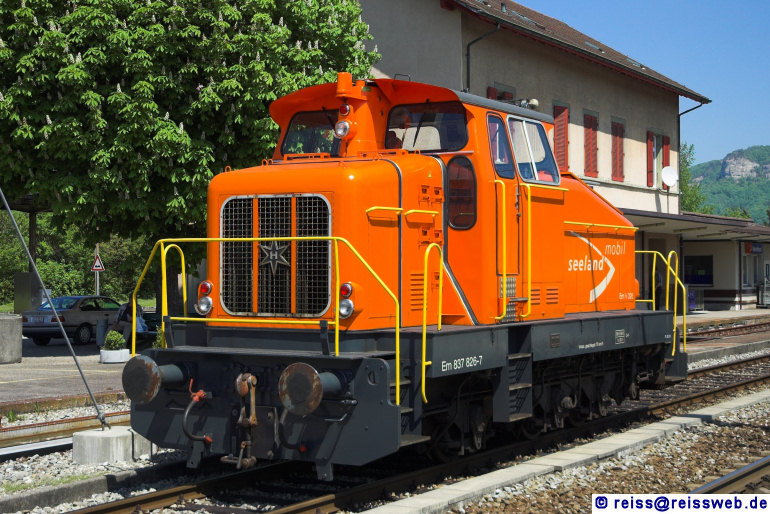
TORONTO, ONTARIO - Of late, I have been spending some time updating the list of every railroad locomotive I have ever noted. The list is organized by railroad in alphabetical order. Since 2004, the first railroad listed has been Aare-Seeland mobil (ASm), which is what amounts to a regional transportation agency in an area along the Aare River between Zurich and Bern, Switzerland. A single locomotive of class Em3/3 (meaning diesel switcher with three powered axles of three total axles) with locomotive number 1 was listed as being spotted in Langental, Switzerland on 15 February 2004.

This entry has always bothered me, since it didn't make sense. Essentially the whole ASm system in meter-gauge. Their sole Em3/3 standard-gauge switcher was assigned to the interchange with the standard-gauge system at Niederbipp, Switzerland. It should not have been in Langental. Furthermore, my notes from the day state that the locomotive was green "and had no notable markings other than the Em3/3 class marking and a large 'M'". In every picture I have ever seen of an ASm locomotive, including the standard-gauge switcher (the best one is on the European Rail Server), it has been orange in color. Furthermore, the pictures did not indicate that it had the number "1", and I don't make up numbers. Had a green locomotive been repainted orange, it didn't seem likely that it would be renumbered from "1".

So, staring at the entry every time I opened the document since it was right at the top, I finally decided to do further investigation. After rather extensive Googling (notably, Bing was useless) I stumbled onto this picture. It's at Niederbipp, not Langental, but it shows a standard-gauge green Em3/3 switcher with a big "M" on the side. It was numbered 2 underneath the "M," but if there's a 2, there's likely a 1 also. I had almost certainly seen its sister locomotive.

Further research revealed that the locomotive was owned by Makies AG, a construction company that runs its own trains about 20 km southeast of where I saw the locomotive. I never turned up a picture of locomotive #1, but it seemed clear enough that my entry needed to be changed. Aare-Seeland mobil has been deleted, and Makies AG added. I no longer have to stare at a suspect entry.

"A" to "Z" in my locomotive listing now runs from the Achenseebahn to the Zillertalbahn. Ironically, both of these lines are narrow gauge railroads out of Jenbach, Austria! I wonder how many railfans have the same bookends, even if what is in between is very different.

Saturday, February 13, 2010

Transport: The Sound of 645's

TORONTO, ONTARIO - Despite being located more than a kilometer from the Canadian Pacific tracks, soon after moving in to my current apartment, I discovered that I could hear trains going by, especially in quiet night and weekend hours. The rumble of the big diesel motors made a sound that, as a railroad enthusiast, I found quite comforting.

As railfans go, I'm not particularly auditory-oriented. The sound of a steam locomotive whistle (or even a well-tuned diesel chime horn) does make me smile, but the normal sounds of diesel locomotives working does not. I have friends who consider the noise of trains to be a fundamental attraction; they will travel miles to hear diesels that they like struggle up a steep grade, and get excited when they hear the same prime mover as used in a locomotive in other applications, usually a ship. Others can identify any train horn that they hear and know what locomotive they might be on.

Despite not really being attracted to the noise, I have been around enough trains that I can usually identify the most common types of engines by ear. Most locomotives produced by the Electro-Motive Division of General Motors (once the dominant locomotive builder, now independent) had either 567, 645, or 710 prime movers, which while certainly having a family "sound" are distinguishable. The 645, introduced in 1965, is the most common, used for example in the ubiquitous SD40-2 locomotive (featured in a previous blog post). The 645 stands for cubic inches of displacement for each cylinder--to put that in perspective, each cylinder in a typical sixteen-cylinder locomotive with a 645 has more displacement than the entire legendary General Motors 427 cubic-inch motor (which, in modern terms, was a humongous 7 liters). It isn't surprising that these prime movers create quite a rumble.

Last year, I began to notice that I wasn't hearing as many trains anymore. While the Canadian Pacific was running fewer trains because of the recession, that wasn't the primary reason. Most trains were being powered by newer General Electric locomotives that were much quieter than a 645; their sound didn't carry to my apartment. I no longer heard the comforting sounds of a train rolling by on a regular basis.

In recent weeks, the Canadian Pacific has apparently seen a surge in traffic, and they have had to bring older power out of storage, even activating SD40-2's from leasing companies to meet their demand. Suddenly, I am hearing 645's rumbling through the neighbourhood all the time--the majority of trains seem to have at least one. The comforting rumbles are back, and now I really appreciate it.

Saturday, January 30, 2010

Transport: Most Common Place Name

TORONTO, ONTARIO - Recently, I finally finished updating the index of my railfanning experiences to the end of 2005. (Can you tell it hasn't been a priority?) More than a decade of serious ralfanning took me to a lot of places, each of which gained an entry in the index. I noted a place name in essentially two cases: When I saw a train or other significant railroad "thing" there, or when I passed through that place on a train. The sample size is large enough that the place names that are repeated makes for an interesting study. For the sake of this discussion, place names that are spelled differently are not counted (e.g. Bern, Switzerland is not considered the same as Berne, Washington even though the one in Washington was named after the one in Switzerland).

Place names that appeared twice were quite common. The list includes Adeliade, Afton, Albany, Alexandria, Argo, Athol, Aurora, Avon, Ayer, Ballard, Bannock, Batavia, Battle Ground, Bayview, Bell, Bellevue, Belmont, Berg, Berkeley, Bethel, Bingen, Bradford, Brunswick, Canaan, Charlotte, Cliff, Clay, Cold Springs, Comstock, Croydon, Edgecomb, Elmhurst, Erlenbach, Exeter, Gardner, Guilford, Georgetown, Glenwood, Goble, Glacier Park, Green River, Halifax, Harrison, Hermosa, Indian Creek, Jamestown, Jordan, Kent, Laufenberg, Las Vegas, Lawrence, Lindsay, Little Falls, Lombard, London, Ludlow, Midway, Milfod, Millersburg, Monroe, Morrisville, Mount Vernon, Newcastle, Newton, Niles, Norwood, Oneida, Park, Pine, Pinkerton, Portland, Providence, Quincy, Radnor, Riverdale, Rockland, Rockwood, Rosemont, Ross, Salem, Selma, Soda Springs, Somerville, Stratford, Syracuse, Tacoma, Thompson, Thornton, Trenton, Verona, Washington, Waterbury, and Wellington. I may have missed others that are considered part of a larger place (Glacier Park, Washington is a siding I have listed under Orillia, Washington, and arguably both Glacier Park and Orillia should be listed under Kent, Washington as they are both within the city limits of Kent).

Twenty-two names appeared three times. They are:
  • Brookfield - Connecticut, Illinois, and Wisconsin
  • Bristol - Illinois, Pennsylvania, and Washington
  • Burlington - Iowa, North Carolina, and Washington
  • Cannon - California, Pennsylvania, and Quebec
  • Clifton - New Jersey, Ontario, and Oregon
  • Essex - Connecticut, Montana, and New York
  • Harrisburg - North Carolina, Oregon, and Pennsylvania
  • Hinsdale - Illinois, Massachusetts, and Montana
  • Hudson - Colorado, New Jersey, and New York
  • Huntington - Massachusetts, Oregon, and West Virginia
  • Lowell - Indiana, Massachusetts, and Washington
  • Marysville - California, Kentucky, and Washington
  • Newark - California, Delaware, and New Jersey
  • Norwich - Connecticut, North Dakota, and Vermont
  • Plymouth - New Hampshire, Massachusetts, and Washington
  • Ramsey - Idaho, New Jersey, and Wyoming
  • Richmond - California, Virginia and Vermont
  • Russell - New Hampshire, Illinois and Massachusetts
  • Summit - Pennsylvania, Utah, and Vermont
  • Wilmington - Delaware, Illinois, and Massachusetts
  • Winona - New Hampshire, Minnesota, and Ontario
  • Woodford - California, New South Wales, and Virginia
Five names appeared four times:
  • Auburn - California, Massachusetts, New South Wales, and Washington
  • Fairfield - California, Connecticut, Iowa, and Oregon
  • Hamilton - Massachusetts, New Jersey, Ohio and Ontario
  • Springfield - Illinois, Massachusetts, Oregon, and Virginia
  • Westport - Connecticut, New York, Oregon, and Vermont
I had thought that Springfield would be the overall winner, as it was a name so generic that it was used for the generic town in the Simpsons, but it didn't even make the top three.

Three names appeared five times:
  • Ashland - New Hampshire, Kentucky, Massachusetts, Oregon, and Virginia
  • Lincoln - California, Illinois, Massachusetts, Nebraska, and New Hampshire
  • Riverside - California, Colorado, Connecticut, Illinois and Vermont
And the big champion, appearing six times? Chester. I have been to the Chesters in Connecticut, Illinois, Massachusetts, Montana, Pennsylvania, and Vermont. I had no idea that Chester was the most prolific railroad place name in my experience.

Tuesday, December 15, 2009

Margin Notes: Burgers, Water, Steam

BELLEVUE, WASHINGTON - For the first time in memory, I had the opportunity to eat at In-N-Out Burger (in Rancho Cordova, California) and Burgerville (in Portland, Oregon) within a few days of one another recently. The two chains, both heavily identified with their local regions and fresh ingredients, make for an interesting comparison. I have to say that I prefer In-N-Out's french fries, but Burgerville makes a tastier burger. I suppose it should, considering that their prices are significantly higher than In-N-Out--I paid less than $7 in California for what cost nearly $10 in Oregon. Burgerville also should receive credit for a very tasty chocolate hazelnut shake.

* * * * * *

Neither burger establishment serves doughnuts. I doubt there would be any policemen at In-N-Out anyway, as in the Sacramento area they all seem to be downtown. Maybe I'm just unlucky, but it seems to me that whenever I have walked around the "Sacramento Valley" railroad station and the state capitol building, I run into at least two police cars driving with their lights on, and my recent experience was no different. I didn't think Sacramento had a reputation as a center of crime, but I've not seen the density of police activity in any other city I've visited in recent years.

* * * * * *


Lookout Point Reservoir east of Eugene, Oregon was quite low in level on 12-December-2009

I was in Sacramento to catch Amtrak's Coast Starlight for the trip north to Portland. The train reaches Klamath Falls, Oregon by morning and then passes over the Cascade Mountains between Chemult and Eugene. The snow at high elevations was to be expected this time of year, but I was a little surprised to find Lookout Point Reservoir to be so low in December--taking the Starlight north was once my routine during my undergraduate years and I don't recall it being anywhere near this low in December.

* * * * * *


This unusual sign was located at Oaks Park in Portland, Oregon--next to the location where the steam locomotives left the station for "Holiday Express" runs--on 13-December-2009

They cannot be to blame for low reservoir levels, but steam locomotives need water to turn it into steam. When departing after a long stop, they have to "blow off" steam, which creates a nice show for observers some distance away, but also means that in this day of lawyer-induced liability concerns, volunteers had to be stationed to keep people from being surprised by steam in their face during the "Holiday Express" event, and leading to the very unusual sign above posted where the "blow off" would occur at Oaks Park in Portland, Oregon.

* * * * * *

As always when passing through town, I sampled the Portland, Oregon radio dial. KEX surprised me somewhat by still maintaining its full hour of news at noon--a rarity on newstalk stations these days--but the real stand-out was KPOJ. The "Power of Justice" progressive talk station actually feels like a local station by having a full local morning show and then local news inserts throughout the day on syndicated programming. I can't think of another left-wing talk station that operates this way--it's not hard to see how it is a rare major (well, #23) market success in a left-leaning station, most of which barely appear in the ratings at all. With Thom Hartmann filling in on its morning show and doing his national show afterward back-to-back on Monday, it was a bit of Thom overkill, but it was still quite listenable for talk radio, something I could not say for Lars Larson on KXL.

Sunday, December 13, 2009

Holiday: Holiday Express 2009


Former Southern Pacific #4449 led the final run of the 2009 Holiday Express along the Oregon Pacific Railroad in Portland, Oregon on 13-December-2009

PORTLAND, OREGON - Despite my loose affiliation with its preservation efforts, I had not managed to ever ride the annual fundraiser for the Oregon Rail Heritage Foundation (ORHF), the Holiday Express. This year, as the ORHF moves forward building a permanent home for the three steam locomotives owned by the city of Portland, Oregon, I decided it was time to climb aboard.


Temperatures barely above freezing led to a great display of steam from the Holiday Express during a morning run at the Ross Island Bridge in Portland, Oregon on 13-December-2009

The weather forecast looked a bit scary for the final of six days of runs today, but freezing rain and snow did not materialize, and the near-freezing temperatures just made the steam locomotive look all the more impressive as it handled the train single-handedly. The sun even came out during a morning run, highlighting the bright paint scheme of former Southern Pacific "Daylight" #4449 which handled this weekend's trains. Last weekend's trains were handled by former Spokane, Portland and Seattle #700.


On board a mid-afternoon run of the Holiday Express, children and their parents enjoyed the scenic views as they awaited a visit from Santa Claus on 13-December-2009

Both inside and outside, the train was decorated for the holidays with strings of multi-colored LED's. On board, though, there was little need to be encouraged to be in a seasonal mood. Everyone knew that Santa would be coming around, giving out candy canes and posing for pictures with children of all ages. While waiting, there was plenty to see out the windows of the Oaks Bottom Wildlife Refuge and the Willamette River, and a deer--not quite a reindeer but as close as one will get in Oregon--even made an appearance as the train approached.


Not quite a reindeer, but a deer did stand on the tracks as the Holiday Express approached on the Oregon Pacific tracks near Oaks Park in Portland, Oregon on 13-December-2009

While the views were pretty during the day, what really sets this train apart is the experience at night, with the lights lining the train as it plied the Oregon Pacific Railroad tracks in the Springwater Corridor. There's something special about hearing a steam whistle at night, and watching multi-colored lights illuminate steam from the locomotive and escaping from the train's steam heating system.


The six cars of the Holiday Express disappeared into the distance on its final run for the year on 13-December-2009

While the last Holiday Express may have run in 2009, the ORHF is always actively seeking support for its efforts, and we can rest assured that the Holiday Express will be back in December 2010.

Wednesday, December 2, 2009

Culture: Canadian Politeness

TORONTO, ONTARIO - I have forgotten which comedian I first heard joke that Canadians apologize to their pieces of furniture when they run into them, as it's a fairly common gag. The only thing is--it's not really a joke. It's true. I have observed at least two Canadians apologize to a sofa or table after stumbling into them, and admit that this is what they had done.

Canadian politeness can be astounding at times, and it always makes me smile. One of my favorite such moments was observed from a TTC bus as I rode through what is regarded as one of Toronto's roughest neighbourhoods, near Jane and Finch. A rather mean-looking individual, someone I would suspect of gang membership even here, was walking down the sidewalk when a car pulled out of a strip mall parking lot and started toward the street. Rather than intimidating the vehicle or just staying out of its way, the man stopped and waved the car by, then kept walking after it cleared. The scene was just quintessentially Canadian.

My first special trip for railroad enthusiasts in Canada, last April out of Guelph, resulted in similar experiences. People offered each other window seats, apologized when they inadvertently got in others' pictures, and just generally seemed well-behaved. The contrast with some of the behavior seen at the Train Festival in Michigan in July could not have been greater, where one photographer ended up putting another in a headlock.

The streak of Canadian railfan politeness continued last night. Many of purist photographers were frustrated by the amount of people in their shots at the actual Canadian Pacific Holiday Train performance at West Toronto, and some of us ended up over at the Old Weston Road pedestrian crossing to try to get some obstructed shots as the train passed that location. Some arrived relatively late, and there wasn't time to coordinate a proper photo line. We did the best we could, but one guy shooting video couldn't take an especially wide shot because of people to his left, and I managed to get in someone's going-away shot because he had moved while the train was going by and I hadn't noticed that in the dark. When the train was out of sight, we all re-gathered at the crossing, and apologized to one another for making our shots more difficult than they needed to be and shared what was on our preview screens from the recent captures. A fight did not break out; in fact, friends were made.

The fact that we were following a Holiday Train designed to spread good cheer and had just watched an uplifting performance probably didn't hurt, but my experience indicates that the same thing would have happened if we had been following any train in Canada, any time of year. Canadian politeness is a powerful force, and it's a shame that it doesn't spread continent-wide.

Wednesday, November 18, 2009

Transport: Farewell, Milwaukee 261


Former Milwaukee Road 4-8-4 #261 tip-toed through the wye at Duluth, Minnesota on 2-June-2007

TORONTO, ONTARIO - A long-rumored decision became official today. In a press release, the National Railroad Museum in Green Bay, Wisconsin announced that Friends of the 261 Chief Operating Officer Steve Sandberg had decided that the organization would not sign an additional lease for former Milwaukee Road steam locomotive #261. Instead, the engine will return to the museum in a cosmetically restored state. After fifteen straight years of excursions ending in 2008, the 261 may never steam again.

Restored steam locomotives, like all steam boilers in their class, are required to be re-certified every fifteen years in a process that often costs well into six figures. The 261's "boiler time" was known to be up in September 2008, so the annual fall trips of the 261 were scheduled earlier than autumn foliage that year to get them in before the locomotive would need to be disassembled for the work. Always nervous about these certifications, I made the decision to travel to Minnesota to ride the last trip, chasing a trip the day before. That decision seems pretty wise now, as I had my chance to enjoy one of the premier mainline steam locomotives one last time.


Former Milwaukee Road #261 was on its home rails at it crossed the Mississippi River at Hastings, Minnesota on its next-to-last run on 13-September-2008

Things started to go sour before the boiler work had made much progress. The National Railroad Museum made it clear that they wanted much more money (double in the first year) than in previous leases for the locomotive, and would only agree to a 10-year lease, rather than 15 or more. The Friends of the 261, officially known as Railroading Heritage of Midwest America, Incorporated, were already struggling to maintain a working organization that ran excursions with the existing lease, prior to the recession. They stopped most work on the locomotive while negotiations proceeded, but the museum didn't budge much. Those hoping for eventual resolution were not heartened when the museum, running a national convention in August, could not come to terms with the Friends of the 4449 and the Friends of the 261 to bring the "Daylight" locomotive #4449, then stored at the 261's shop in Minneapolis, to the convention.

Rumors have been flying for some time about what the Friends of the 261 might do if terms could not be reached on the 261. Most of the speculation surrounds locomotives at the Illinois Railroad Museum, including "sister" former Milwaukee Road 265. Whether the highly mechanically skilled and business savvy Sandberg organization will tackle another locomotive remains to be seen, but at the very least, one can expect guest locomotives from other organizations to be visiting the Twin Cities in the immediate future. The 261 may be finished, but the organization and its marquee rolling stock (including a former Milwaukee Road full dome and "Skytop" observation car) is not.


My final picture of former Milwaukee Road #261 would prove to be this one at Harrison Street in Minneapolis, Minnesota on 14-September-2009, as the locomotive pulled away from its last train and headed for the shop, its fires to be cooled for the final time

This blog has a certain attachment to the 261, as the first time blog entries were made outside of Toronto was on the trip to ride what proved to be the 261's final run. In one of the first margin notes, I stated that I was looking forward to the return of the 261 to the rails. Now, I'll just have to state that I'm looking forward to whatever Railroading Heritage of Midwest America, Incorporated comes up with for its future.

Friday, November 6, 2009

Transport: Coming and Going


CANDO Contracting's rebuilt GP9u #4009 was captured by James Resor at Lambton Yard in Toronto, Ontario on 27-July-2008; photo used with permission

TORONTO, ONTARIO - I have yet to experience the Orangeville-Brampton Railway (OBRY). The line between Streetsville Junction in Mississauga, Ontario and Orangeville, Ontario operates past the Forks of the Credit River on a line scenic enough to support the Credit Valley Explorer excursion trains. Owned by the town of Orangeville, the line is operated by CANDO, a contractor based in Brandon, Manitoba, well regarded in the railroad industry.

Despite never having seen the railway, I didn't need to leave my own neighbourhood to see the locomotives it has used in recent years. Last summer, the line received "new" motive power. One evening, my fellow Toronto Railway Historical Association volunteer James Resor happened to catch a unit stenciled "CCGX 4009" at Canadian Pacific's Lambton Yard, which is walking distance from my residence. James had to do research, but "CCGX" is registered to CANDO, and the 4009 was discovered to be headed to the OBRY. While the unit might be new to that line and had been rebuilt in 1990, it had originally been constructed in 1959 for the Canadian National. By the time I found out about it, Canadian Pacific had already delivered the locomotive to Streetsville.

The 4009 was headed to the OBRY because the existing power was showing its age. The CCGX 1000 was actually the same GP9 model as the 4009, but it had never been re-manufactured since being built for the Quebec, North Shore and Labrador in 1956. Visually, it looks quite different since it has retained its original high nose.

On 27 October, it hit railfan discussion boards that 1000 was in Streetsville, and soon it was realized that it was being moved to the Canada Cement/Lafarge plant in Bath, Ontario, on the Bath spur off the Canadian National Kingston Sub. Another CANDO operation, the plant would be a less demanding environment for the aging locomotive. I wondered if I would miss the outbound unit just like I had missed the inbound, as reports had the locomotive moving to Leaside Yard in Toronto, then to Toronto (Agincourt) Yard via Streetsville. Finally, when I walked past the now-closed Lambton Yard office yesterday, I found the 1000 there, waiting to be interchanged to the Canadian National.


CANDO Contracting's GP9 #1000 had left the Orangeville-Brampton Railway enroute to Bath, Ontario, and was noted at Lambton Yard in Toronto, Ontario on 6-November-2009

Sometimes the key to railfanning is not going to the right place, but waiting for the right things to come to you. That, and having a good network of friends to catch what you miss.

Wednesday, September 30, 2009

Transport: A Train A Day


My first train of the month was GO Transit train #254 from Bramalea to Toronto, Ontario passing through the construction site at West Toronto on 1-September-2009.

TORONTO, ONTARIO - This past month, I made a decision I had never made before. I decided I was going to see and "log" at least a train a day every day for the month. I had set similar goals on vacations before, but I had never kept up such a streak for an entire month.


My most frequently seen train of the month was Canadian Pacific's "Streetsville Turn," seen here heading west at Royal York in Toronto, Ontario with rare "Gen-set" locomotive 3GS21B #2100 leading on 4-September-2009

It's fairly common to end up seeing more than one train when setting out to see one, but I would not have predicted that the train count would be 78 for the month. 36 were GO Transit commuter trains, 21 were Canadian Pacific freight trains, 19 were VIA Rail Canada intercity passenger trains, and 2 were Canadian National freight trains. The most frequently-seen single train was Canadian Pacific's often-short Streetsville Turn local freight, seen seven times, though arguably the GO Transit trains were the fixture of the month, as they all look the same expect for having 10-car or 12-car lengths and having F59PH's or MP40PH-3C's for power.


The "Prince Albert Park" sleeper-lounge-dome-observation car carried the markers of VIA's premier train, the "Canadian," as it headed to the yard after its arrival at Toronto's Union Station on 17-September-2009

Unsurprisingly, I saw the most trains (28) around Union Station, where in one instance I arrived ten minutes early to see a specific train and ended up seeing eleven movements. The most interesting trains were VIA's "Canadian" transcontinental train, which runs only three times a week and features multiple dome cars, the Canadian Pacific train that ran out of gas already featured on this blog, and the GO Transit trains that detoured on a normally freight-only line because of fire hoses over their normal roue.


My final train of the month was Toronto-Chicago train #243, seen passing the old Lambton station site in Toronto on 30-September-2009

I can now say that I've gone an entire month seeing at least a train a day, but I'm unlikely to try any such thing again. It was clearly a waste of time to head out in light rain just to catch a GO train going by in poor photographic conditions. Quantity is over-rated, and I'm back to pursuing quality again.

Friday, August 14, 2009

Transport: Not Seeing What's There


St. Lawrence and Hudson SD40-2 #5560 led Canadian Pacific "Expressway" train #124 over the Humber River in Toronto, Ontario on 14-August-2009

TORONTO, ONTARIO - In a past post, I mused on the fact that it is not uncommon for a railroad enthusiast to not even realize the significance of what one is seeing in front of them until doing some later research. Sometimes, though, the disconnect is much simpler--not even seeing what is right in one's viewfinder, with obvious significance, until looking at the picture later.

I had such an experience tonight when I followed my occasional routine of heading down to the Humber River in Toronto to take pictures of whatever Canadian Pacific trains might pass through in sunset light. Since recent changes resulting from the poor economy, this has not been a very fruitful activity, as several trains that used to fairly reliably pass in that general time frame no longer run.

Tonight, the only train to pass was one of the remaining common trains, Expressway train #124 which runs overnight trailers from Hornby, Ontario west of Toronto to Montreal, Quebec. It showed up after ideal light but before complete darkness, and I was able to get a passable picture, seen above.


In a more obvious situation, St. Lawrence and Hudson SD40-2 #5560 was in westbound Expressway train #121 at Scarlett Road in Toronto, Ontario on 5-May-2008.

At the time, I was somewhat disappointed as looking through my viewfinder, it looked like the lead locomotive was in a Candy Apple Red paint scheme, in contrast with the second unit which had an older Action Red paint scheme. They didn't match, and since the train had been operating with matching Action Red units, I wasn't happy with the change on the front of the train.

Upon processing my digital photos tonight, however, I discovered that the lead unit was indeed in Candy Apple Red, but was not a Canadian Pacific unit. It was painted in the St. Lawrence and Hudson paint scheme. There were only four such SD40-2 locomotives remaining in service on the Canadian Pacific, so this was a quite rare train that I had captured!

The St. Lawrence and Hudson was a 1996 attempt by Canadian Pacific to make the eastern half of its system east of Chicago and in the northeastern United States more efficient. It was thought that the railroad was intending to sell off this portion of its system, but instead the performance on this portion of the railroad improved so dramatically that just a year later, it was decided to keep the entire St. Lawrence and Hudson in the Canadian Pacific system. As a relatively brief experiment, it was surprising that any sign of the St. Lawrence and Hudson remained more than ten years later at all.


GP9u's #8212 and #8219 showed the difference between the St. Lawrence and Hudson and Canadian Pacific paint schemes at Lambton Yard in Toronto, Ontario on 21-June-2006. The yard is now closed, and #8212 was repainted back to CP paint in 2007.

Sometimes, it's not just obscure things that the railroad enthusiast misses when looking through a viewfinder. Sometimes, it's the obvious.

Tuesday, July 28, 2009

Transport: Reacting to a Steam Locomotive


A lone photographer on a ladder was noted in the middle of a field near Baldwin Road outside of Owosso, Michigan on 26-July-2009

TORONTO, ONTARIO - One of the joys of riding behind a steam locomotive is watching the reaction of people along the tracks. Whenever a large steam locomotive moves, a hoard of railroad photographers generally chases the train, and their antics can be anything from amusing (such as the man on a ladder seen above) to horrifying (such as the man reported to be steering with his knees at high speed while chasing an all-day Train Festival excursion earlier last weekend in central Michigan).


A van with an open door paced former Nickel Plate #765, a large steam locomotive, as it ran back to Owosso, Michigan along King Road on 26-July-2009. The train had slowed to about 25 mph by this time.

These railroad fans who knew that the train would be operating are not nearly as much fun to watch as locals who did not know that the train was coming. Some just drop their jaws. Others are seen breaking into a Steve Martin-style "What the @#!% is that?" routine. Children can even run in fear, or, fortunately more commonly, jump for joy. Inevitably, just about everyone waves.


Rafters on the Deschutes River near Tuscan, Oregon reacted to the passage of the "Daylight" steam locomotive on 16-September-2006.

Even locals that have heard that train is coming--and perhaps have even set out lawn chairs as they waited for it to come by--can be entertaining. The children, especially, can have unpredictable reactions. Quite a number seem to be captured with the awe that inspires many of them to be future crew members of steam locomotives, or at least future passengers of the trains.


Will she be a future steam engineer? Two children joined an older family member in watching the passage of Nickel Plate Road #765 through Bannister, Michigan on 26-July-2009

A few people, of course, are completely oblivious to the passage of the special train. They are so intent on what they are doing--whether it be fishing, digging for clams, or just household chores, that they pay no attention to the rare event unfolding before them. I find these people the hardest to explain--is a short wave not at least called for when a steam train goes by?


Two fishermen in the Black River near La Crosse, Wisconsin were practically oblivious to the passage of Milwaukee Road #261, a large steam locomotive, on 16-September-2008.

One of my all-time favorite scenes while watching steam locomotive observers was not captured in a photo. A man had set up for a photograph of the "Deschutes River Daylight" returning from Bend to Portland, Oregon in September 2006. As the steam locomotive passed, he apparently lost his balance and fell straight into a ditch. I never heard who it was, or whether his shot taken before the fall turned out.

One never knows what one will see from a steam train, but the people will always be entertaining.

Sunday, July 26, 2009

Travel: Three Days, Three Rides


A one-eighth scale model of a Pennsylvania Railroad diesel approached the loading location at the Train Festival in Owosso, Michigan on 24-July-2009

FLINT, MICHIGAN - Just about every possible aspect of railroading made an impression during the now-completed Train Festival in Owosso, Michigan this weekend. From purchasing railroad memorabilia to observing model railroads to operating a steam locomotives to taking night photos of trains, it was all possible, assuming one bought a ticket early enough since many events sold out. Train riding was obviously one of the options available. In my three days at the Train Festival, I decided to ride a train a day, and as it worked out, the trains became larger each day.


In a view taken from a trailing passenger car, the miniature Pennsylvania diesel paused near a whistle sign featuring a Keystone logo during the Train Festival in Owosso, Michigan on 24-July-2009

I spent a good portion of Friday checking out the Train Festival grounds, and one of the prominent features was a one-eighth scale miniature railroad. Both steam and diesel locomotives were operating on the route, and I ended up taking about a five minute ride behind a Pennsylvania Railroad diesel across the grounds.


Little River "Pacific"-type steam locomotive #110 powered the hourly runs during the Steam Festival; the peppy engine approached Main Street in Owosso, Michigan on 25-July-2009

On Saturday, I stepped up to full size trains. Throughout the festival, an excursion train ran hourly about four miles out and back, hauled one direction by a Great Lakes Central diesel and the back to the grounds by Little River Railroad 4-6-2 ("Pacific") #110. The eight-car train provided interesting riding options including cars from the original Chicago bi-level gallery commuter coaches from the Chicago, Burlington and Quincy. The brief ride was just a warm up for the next day.


Nickel Plate Road "Berkshire" #765 accelerated during a photo run-by at Ithaca, Michigan on 26-July-2009

On the last day of the festival, I rode the all-day excursion behind a "super power" steam locomotive, Nickel Plate Road #765. The 2-8-4 "Berkshire" easily handled the sixteen car train on a nearly 40-mile trip to Alma, Michigan and back. Included in this trip was a stop for multiple photo run-bys, allowing those riding the train to get pictures instead of just non-paying chasers (which I had been the previous two days). It was a fitting highlight to a complete railroading experience.

For more coverage of Train Festival 2009, visit the steam forum at Trainorders.com including a thread I started.

Saturday, May 30, 2009

Transport: Ten Years After Conrail


The only former Conrail locomotive seen in Worcester, Massachusetts ten years after the Conrail break-up was CSX DASH8-40CW #7340, once Conrail #6148, on 30-May-2009

WARE, MASSACHUSETTS - Ten years ago on Monday, Conrail ceased to exist as we knew it. The once government-owned company created in 1976 to run a series of bankrupt railroads in the eastern, especially northeastern, United States, profitable since 1981 and privatized in 1987, was split up between its two main competitors in the east, CSX Transportation and Norfolk Southern.

Living in Boston at the time, Conrail was my local railroad, so while I had done little railfanning in Massachusetts at the time, I decided I needed to head out to see the last weekend of Conrail. While 1 June fell on a Tuesday in 1999, many fewer trains would run on Sunday and Memorial Day, so I picked 29 May 1999 as my first and last day-long Conrail experience. On the advice of other local railfans, I headed out to Worcester, Massachusetts and took in the action.


On the last weekend of Conrail, a SD80MAC led the Framingham, Massachusetts to Selkirk, New York train through Worcester, Massachusetts on 29 May 1999

I wasn't disappointed, with a nice parade of trains, a variety of locomotives from B23-7's to SD80MAC's, and quite a few railfans out for the experience. The day went so well that I decided to return to Worcester regularly to document any changes that new owner CSX would implement. Amongst other times, I returned three months later, six months year, one year later, two years later, and five years later, always on a Saturday to try to make any comparisons more meaningful. It seemed my duty, therefore, to show up again ten years later to again survey the changes.

Taken between any two of my visits, the changes in operating practice generally seemed rather subtle (except, perhaps, for the invasion of new CSX AC6000CW locomotives in 2001). Taken over the course of ten years, the changes seemed dramatic. Except for a few run-through units, all the locomotives in 1999 were in Conrail blue. In 2009, all the units were in a CSX paint scheme, and only one, a DASH8-40CW pictured above, was of Conrail heritage. In 1999, there were three eastbound intermodal (piggyback or container) trains noted passing through Worcester in daylight hours. In 2009, there was just one. Guilford (now Pan Am Railways) no longer ran an interchange train into East Worcester Yard; all interchange was taking place at Ayer. The overall freight train count was 16 in 1999 and just six in 2009.

Physically, except for a few old blue signs, it was hard to tell that the line had ever been Conrail and not always CSX (to say nothing of the Boston & Albany and the companies that came between it and Conrail). Operationally, the Conrail Boston Line dispatcher had become the CSX NA Dispatcher and a new call-in radio channel was in use, even if the dispatcher was still in Selkirk, New York. All of the train symbols had changed immediately after the merger and had been modified over the decade.


One of the few physical signs of the Boston Line's Conrail heritage still visible in Worcester, Massachusetts on 30 May 2009 were the white-on-blue signs marking "CP 45", a major junction in Worcester, 45 miles from Boston

Passenger service had changed over the ten years as well, with the "Bay State" Amtrak trains to New York via Springfield discontinued, Amtrak "Lake Shore Limited" schedule changes, the MBTA expanding its weekend round trips to Worcester from Boston, the re-opening of Union Station and the closing of the small former Amtrak station, and the coming of intercity buses to Union Station as an intermodal terminal.

It's the ability to make these kind of comparisons that justify my note-taking while railfanning. I have the notes to prove that a lot has changed in the past decade in Worcester, Massachusetts since the end of Conrail.

Tuesday, May 5, 2009

Heritage: 70 mph Behind Steam


The "Western Pacific" heritage diesel sat next to Union Pacific steam locomotive #844 near the Western Pacific Railroad Museum in Portola, California on 5-May-2009

RENO, NEVADA - Steam locomotives running on "mainline" freight tracks are not common in North America. Thanks to liability concerns and the small number of operational steam locomotives that are large enough to pull a long passenger train, the number of such runs in a given year is often small. At one point earlier this year, it looked like there might be only two the entire year of 2009 in the United States. (The picture looks much rosier now; while one of those anticipated trips was canceled, it appears that the total this year will be similar to last year.)


Union Pacific steam locomotive #844, built in 1944, led the passenger special near Scotts, California on 5-May-2009

Opportunities to ride on such excursions on routes not regularly traversed by Amtrak trains are even rarer. Thanks to an invitation from the Western Pacific Railroad Museum, I was able to ride on just such a trip segment today, as a Union Pacific special ran from Portola, California to Winnemucca, Nevada on the former Western Pacific line which today is normally traversed only by freight trains.


The "Walter Dean" dome car was amongst the rolling stock that we were allowed to enjoy during the trip, seen with the end of the train from the vestibule near Scotts, California on 5-May-2009

Union Pacific excursions are always a joy to ride because of the immaculate passenger equipment the railroad maintains for its business and excursion fleet. Included in the train today were a dome car normally assigned to the business car fleet and a coach that was the first car I had ever car hosted in fourteen years ago, and thanks to the small number of passengers, I spent virtually all my time either in the dome car or a vestibule, enjoying the ability to watch the steam locomotive by sticking my head out the side of the train.


Union Pacific steam locomotive #844 crested the grade at Sand Pass, Nevada without diesel assistance on 5-May-2009

That view was especially rare today not only because the steam locomotive was running unassisted up mountain grades (both Sand Pass and Antelope Hill), but because there were sections of 70 mph running on the line. There was no question that the steam locomotive was handling the train, and there was no question that it could make track speed. I had never ridden behind steam at 70 mph before, and I had never felt the wind in my face at that speed on a train before. It was truly an unforgettable day.

My thanks goes out to the Western Pacific Railroad Museum and the Union Pacific Railroad for making the experience possible.